Storage & ASRS Systems
Storage systems that improve space utilization while supporting faster, more organized fulfillment operations.
Pallet rack, shelving and ASRS solve different problems.
Storage is often where operations run out of capacity first, and the wrong decision can be difficult and expensive to reverse.
Siggins designs warehouse storage systems around how inventory actually moves through the operation from pallet rack and warehouse shelving to high-density automated storage and retrieval systems (AS/RS).
Depending on the facility, inventory profile and technology applied, the right storage strategy can significantly increase storage density while maintaining the accessibility and throughput the operation requires.
Storage Density Only Matters if Product Remains Accessible
Maximizing storage locations isn’t the same as optimizing storage.
Every location has to support the velocity, replenishment requirements and picking methods of the products stored there. Increasing density at the expense of accessibility can simply move the constraint from storage capacity to picking and replenishment.
That’s why we evaluate storage density, inventory velocity, accessibility and material flow together before determining the right storage strategy.
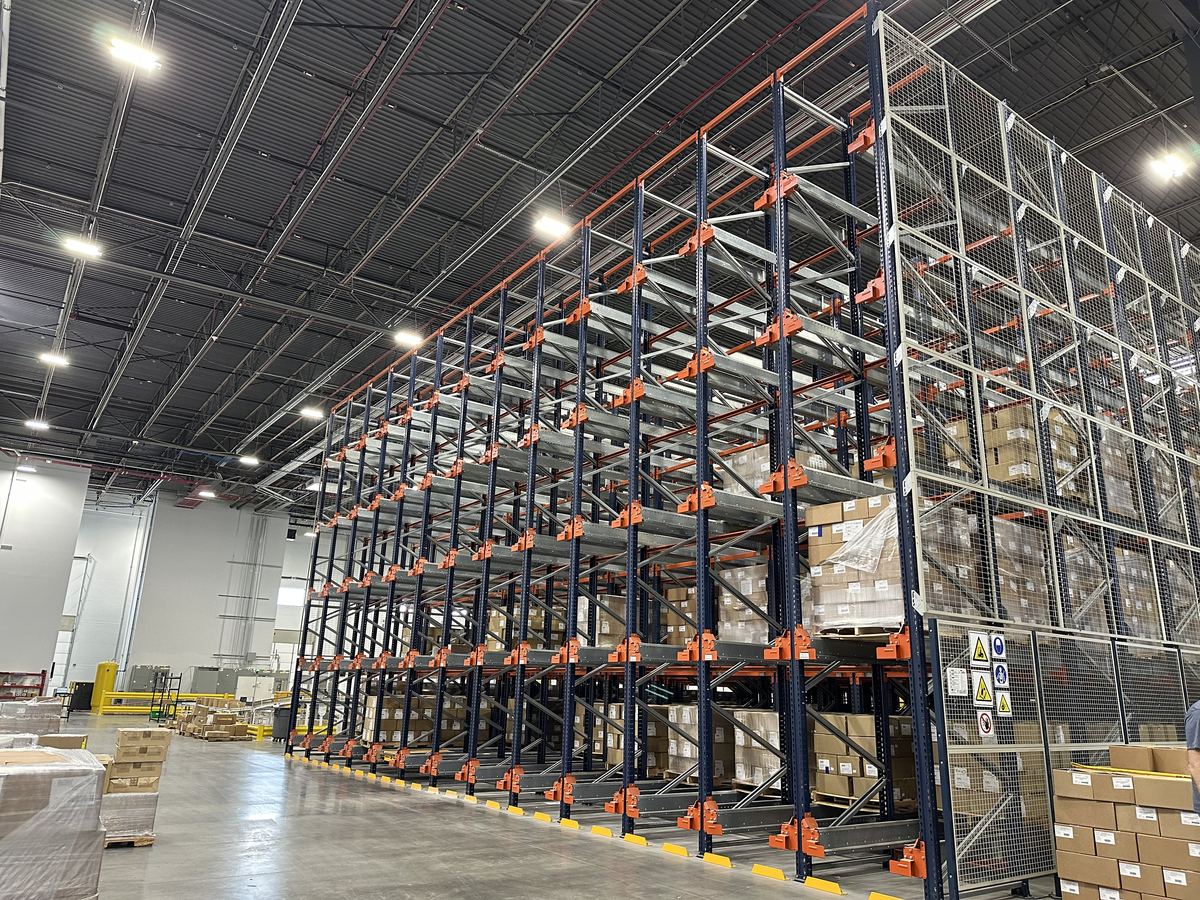
Pallet Rack
Pallet rack isn’t just about fitting more pallet positions into the building. Those positions also have to be accessible at the rate your operation requires.
We design pallet storage around product characteristics, inventory velocity and pick profile, using solutions such as:
- Selective pallet rack
- Pallet flow rack
- Very-narrow-aisle (VNA) racking
- Cantilever rack
- Reel racking
- High-density pallet storage
The right configuration can increase storage capacity while maintaining efficient replenishment, picking and material movement.
Warehouse Shelving & Carton Flow
For smaller items and operations with higher SKU counts, warehouse shelving and carton flow systems can increase pick density without adding square footage.
Solutions can include:
- Decked shelf-pick rack
- Carton flow
- Bin and shelving systems
- Multi-level storage and picking configurations
- Pick-to-cart applications
We evaluate pick density, replenishment, travel and ergonomics together.
More storage isn’t an improvement if inventory becomes harder or slower to access.
Automated Storage & Retrieval Systems (AS/RS)
When storage density, labor requirements and throughput justify automation, automated storage and retrieval systems (AS/RS) can dramatically change how inventory is stored and presented to operators.
Because we’re not tied to a single manufacturer or technology, we can evaluate different AS/RS approaches based on what the operation needs to accomplish.
Shuttle-based systems
Combine high storage density with high throughput and can make effective use of vertical space. System configuration, redundancy and workstation design are critical to achieving the required performance.
Grid-based systems
Create dense tote storage within a compact footprint and can work particularly well where building height is limited. Throughput depends on system configuration, inventory distribution and the number of robots and access ports.
Vertical lift modules (VLMs)
Use vertical space to reduce the floor area required for storage while bringing inventory directly to the operator. They can accommodate a broad range of products, with different throughput characteristics than higher-speed AS/RS technologies.
The right technology depends on throughput, inventory profile, available space, building constraints, labor requirements and capital investment.
We model those tradeoffs before recommending a direction.
Automate the Inventory That Benefits From Automation
Not every SKU needs automated storage.
Slower-moving inventory may be better served by very-narrow-aisle storage, shelving or pick-to-cart strategies that improve space utilization and picking efficiency at a lower capital investment.
Faster-moving inventory may benefit from carton flow, pallet flow, goods-to-person or automated storage, depending on order profiles and required throughput.
In many operations, the best answer is a hybrid storage strategy that applies different storage methods to different inventory profiles rather than forcing every SKU into the same solution.
Design for Capacity and Flow
Storage decisions affect more than capacity. They influence replenishment, picking, travel, material flow, labor and future expansion.
Our engineers analyze inventory and movement requirements, evaluate storage alternatives and model the capacity and throughput the operation needs to support before equipment is selected.
The result is a storage system designed not simply to hold more inventory, but to make better use of the building while keeping product moving.
What improves:
- Storage density and capacity
- Space utilization
- Inventory accessibility
- Picking and replenishment efficiency
- Fulfillment speed
- Labor utilization
- Operational flexibility
Start with a SOLVE Analysis
Understand what your operation needs before committing to equipment or automation decisions.

Warehousing and Distribution Solutions